
Commercial solar for UK organisations
Free commercial solar site surveys that show whether solar pays
We check your roof, structure, grid connection and energy use, then give your finance team a costed system, savings and payback.
- Free and no obligation
- On site or by video call
- One MCS certified installer
- Board-ready cost and payback
Surveys for warehouses, factories, farms, schools and multi-site estates in England, Scotland, Wales and Northern Ireland.
Why start with a survey
Board-ready numbers
System size, cost range, savings and payback set out clearly, with every assumption stated.
One matched installer
Your details go to one MCS certified installer matched to your site, not a list of companies.
On site or by video
Start with a virtual assessment, or have the roof, structure and intake inspected in person.
Free, with no obligation
The survey costs nothing. You decide afterwards whether the numbers justify going ahead.
How it works
Four steps from enquiry to a decision
A survey is the cheapest point at which to find out whether solar works on your site, and what would stop it.
Step 1
Tell us about the site
Six quick questions and your details. It takes under two minutes.
Step 2
Qualifying call
We talk through the building, your bills and your goals, and check a survey is worthwhile.
Step 3
Free site survey
One MCS certified installer matched to your site surveys it, on site or by video call.
Step 4
Report and decision
System size, generation, cost range, savings and payback to take to your board. No obligation.
What the report includes
Everything your board needs to judge the investment
- Energy useBills and half-hourly data, so the system is sized to what you use in daylight hours.
- Roof and structureCovering, condition, remaining life, fragile areas and whether an engineer's check is needed.
- Grid connectionSupply capacity, the G98 or G99 route and whether export may be limited.
- Design and yieldPanel layout, system size in kWp and expected annual generation for your location.
- Costs and paybackAn installed cost range, annual savings and an illustrative payback period.
- Finance optionsHow purchase, a loan, a lease or a PPA would work for your organisation.
Commercial solar survey report
Distribution warehouse, example site
- System size
- 100 kWp
- Generation
- 90 MWh a year
- Installed cost
- £90k excl. VAT
- Annual benefit
- £18,180
Generation by month
- Roof condition and remaining life
- G98 or G99 route and export limit
- Whether an engineer's check is needed
- Purchase, loan, lease or PPA compared
Sectors
Surveys shaped around how your sector uses power
Demand patterns decide how much generation you use on site, and that decides payback.
- WarehousesLarge unshaded roofs and daytime shift work make many warehouses a strong fit for rooftop solar, provided the roof structure, rooflights and lease terms stack up.
- FactoriesFactories with heavy daytime process loads can use nearly all the solar they generate. The survey focuses on the electrical system, roof condition and how to install without stopping production.
- FarmsDairy, poultry and grain enterprises can make good use of solar on sheds or land. A farm survey looks closely at seasonal demand, building condition and rural grid capacity.
- OfficesWeekday daytime demand suits solar, but office roofs are small and busy. The survey looks at roof plant, carports, multi-tenant supplies and landlord consent.
- SchoolsSchools, academies and colleges have daytime demand but long summer closures. The survey models term-time use against holiday export and flags building and approval issues early.
- RetailSeven-day trading and refrigeration make retail a strong match for solar. The survey covers roofs, car park canopies, customer safety and tenant and landlord arrangements.
- HospitalityHotels and holiday parks with summer peaks match solar well, while evening-led pubs and restaurants need careful sizing. The survey looks at hot water, kitchens, seasons and historic buildings.
- HealthcareContinuous demand in care homes and daytime clinical loads in surgeries and clinics suit solar. The survey focuses on backup power, fire strategy, occupied buildings and lease arrangements.
- Charities and communityCharity buildings range from daily offices to occasional-use halls and historic churches. The survey tests whether demand matches generation and highlights VAT, heritage and governance points.
- Food and drinkRefrigeration and process cooling give food and drink sites a strong match with solar. The survey pays close attention to hygiene zones, insulated panel roofs and fire risk.
- Commercial landlordsSolar on let property means settling who pays, who benefits and who owns the system. This page covers the main ownership models, lease length, metering and MEES.
- Not listed?Every commercial site is differentTell us about yours and we will check whether a survey is worthwhile.Book a free site survey
Costs and payback
What commercial solar costs, and how it pays back
Cost per kWp falls as systems get larger. These are illustrative UK ranges for rooftop systems, excluding VAT.
| System size | Illustrative cost per kWp |
|---|---|
| 10 to 50 kWp | £1,000 to £1,500 |
| 50 to 250 kWp | £750 to £1,100 |
| 250 kWp to 1 MWp | £600 to £900 |
Illustrative ranges excluding VAT. Access, roof condition, structure and grid works can move a project outside them.
Cumulative cash position, 100 kWp example
£90,000 cost, about £18,180 benefit a year, break-even in year 5
Roofs and land
Every roof type has its own checks
Profiled metal, membrane flat roofs, slate, asbestos cement, open land and car parks each need a different approach to fixing, loading and safety.
- Flat roofsHow membrane type, ballasted or fixed mounting, east-west layouts, parapets, drainage and roof loading decide whether a flat roof suits solar.
 Metal roofsTrapezoidal, standing seam and composite panel roofs: how mounting, rooflights, fixings and sheet age affect a solar installation.
- Pitched roofsTile and slate roofs on older commercial and agricultural buildings: in-roof or on-roof mounting, rafters, orientation and heritage limits.
- Asbestos roofsAsbestos cement roof sheets: the legal duties, survey types, fragility, and the overcladding or replacement routes to a safe solar installation.
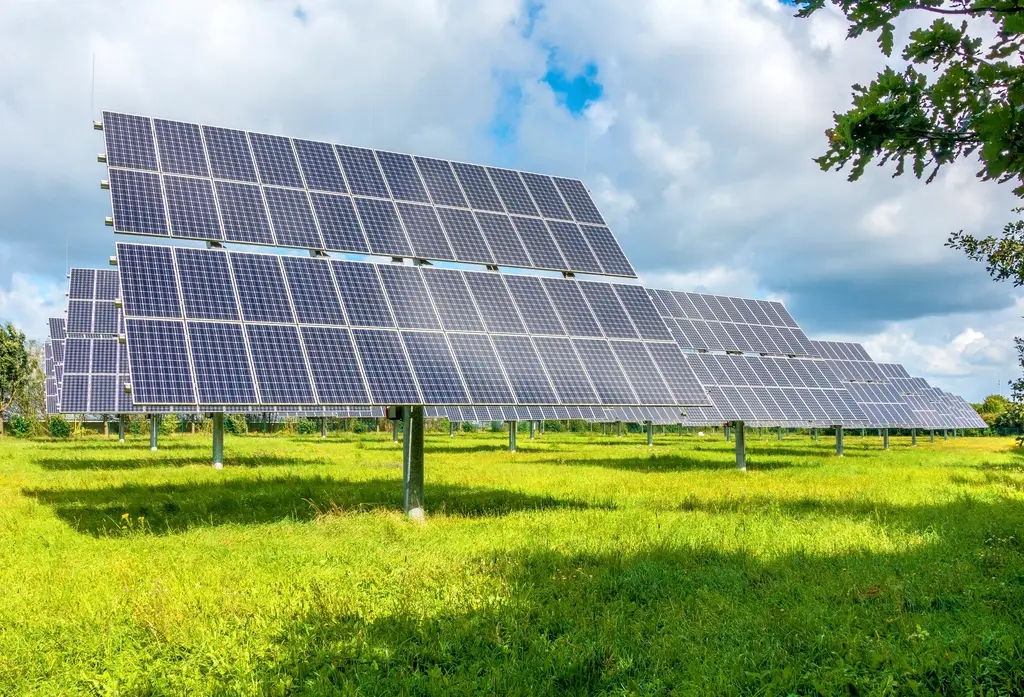 Ground-mounted solarGround-mounted solar on business or farm land: planning, land choice, cable runs, grid connection, security and biodiversity.
 Solar carportsSolar car park canopies: permitted development in England, foundations and drainage, structural design, EV charging and how costs compare with rooftop solar.
Finance
Buy it, finance it, or pay only for the power
Each route changes who owns the system, who claims the tax relief and how much of the saving you keep.
CapEx vs loan vs lease vs PPA at a glance
| Feature | Keeps all savingsOutright purchase (CapEx) | Loan or hire purchase | Lease | Power purchase agreement (PPA) |
|---|---|---|---|---|
| Upfront cost | Full installed cost | Little or none (a deposit may apply) | Usually none | None |
| Who owns the system | You | You (at the end of the term with hire purchase) | The funder | The PPA provider |
| What you pay | Nothing further except running costs | Fixed repayments over the term | Fixed rentals over the term | An agreed rate for each kWh the system produces |
| Who keeps the savings | You keep all of them | You, less the repayments | You, less the rentals | The difference between the PPA rate and your grid rate |
| Capital allowances | You can usually claim | You can usually claim | Usually the funder claims | The provider claims |
| Maintenance | Your responsibility | Your responsibility | Depends on the agreement | Usually the provider's |
| Typical term | Not applicable | Typically several years | Typically several years | Typically 15 to 25 years |
| Often suits | Strong cash position, taxable profits, long tenure | Ownership benefits without the upfront outlay | Fixed costs with the asset off your hands | Larger sites wanting savings with no capital spend |
General comparison only. Terms, tax treatment and accounting vary by provider and by business: check the detail with your accountant and any finance provider. We do not provide finance. See PPA vs CapEx for the full comparison.
Grants and reliefs by nation
- EnglandBusiness rates exemption for onsite renewables, tax reliefs and sector schemes.Read more
- ScotlandScottish rates relief, loans and community schemes, with different rules.Read more
- WalesWelsh rates relief, Development Bank of Wales loans and Welsh Government support.Read more
- Northern IrelandSeparate rating, planning and export arrangements via NIE Networks.Read more
Across the UK
Surveys in every region and nation
Your network operator, planning rules, solar yield and available support all depend on where the site is.
Indicative UK yield
800 to 1,050 kWh
per kWp a year, higher in the south
Guides
In-depth guides for decision makers
- Planning permissionPermitted development for commercial rooftop solar and car park canopies in England, prior approval, heritage limits, ground-mounted schemes and the other UK nations.
- Fire safety and insuranceRC62 in plain terms, insurer questions, DC isolation, cable routing, separation from rooflights and fire breaks, and inspection regimes for commercial rooftop solar.
- Solar panel lifespanProduct and performance warranties, degradation, inverter replacement, roof life, end of life recycling and how lifespan affects payback and lease length.
- Survey checklistA practical checklist of the energy data, drawings, consents and decisions to gather before a commercial solar survey, plus what to expect on the day and after.
- Choosing an installerCertification by system size, insurance, warranties, design documents, yield assumptions, questions to ask and red flags, with a table for comparing quotes like for like.
- Solar maintenanceMonitoring, inspections, cleaning, thermography, electrical testing, bird proofing, roof access safety, O&M contracts and what insurers expect from rooftop PV owners.
FAQs
Commercial solar survey questions
Straight answers to what finance directors and estates managers ask most.
Is the commercial solar survey really free?
Yes. There is no charge for the survey and no obligation to go ahead. We review your enquiry, talk to you about the site, and if it looks suitable we arrange the survey with one MCS certified installer matched to your site. You only pay anything if you later choose to buy a system.
Who carries out the survey?
One MCS certified installer that we match to your site, based on its size, location and roof type. Your details go to that one installer only, so you are not passed around a list of companies. See how a survey works for each step.
What size of business is this for?
Any UK organisation with its own roof, land or car park and a meaningful daytime electricity bill: warehouses, factories, farms, offices, shops, hotels, schools, care homes, charities and landlords. As a rough guide, sites spending a few hundred pounds a month or more on electricity are usually worth a look.
Can I have a survey if I lease the building?
Yes. Many tenants install solar with the landlord's consent, and landlords can install it and sell the power to tenants. The survey looks at the lease, who pays the bills and how long you will be in the building. Read our page for commercial landlords and tenants.
How long does a commercial solar survey take?
A virtual survey usually takes under an hour once your bills and site details are to hand. An on-site survey of a typical commercial roof often takes a few hours. Larger or more complex sites may need follow-up work such as a structural engineer's report or a grid application.
What does commercial solar cost?
Illustratively, rooftop systems cost about £1,000 to £1,500 per kWp for 10 to 50 kWp, falling to about £600 to £900 per kWp for 250 kWp to 1 MWp, excluding VAT. Your survey gives a range for your roof. See the commercial solar cost guide.
Find out what your roof could generate, cost and save
Six quick questions and your details. Free, with no obligation.